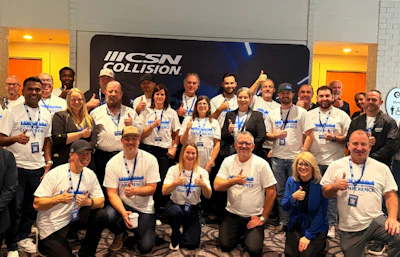
CSN Collision's western regional conference in Kelowna brought together 103 representatives from 77 repair facilities to address repair delays, shop profitability, and practical AI applications. The event emphasized that incomplete repair planning causes costly supplements and interruptions, while clear accountability, proper documentation, and straightforward AI tools can significantly improve operational efficiency and bottom-line results.
- 103 attendees from 77 repair facilities across British Columbia and Alberta gathered for CSN's first western regional conference in Kelowna on October 21-22
- Incomplete repair plans trigger supplements, approval delays, and production stoppages that involve multiple people and extend costs beyond the added operation
- Recommended best practices include a dedicated planning area, consistent processes, and clear checkpoints before production begins, plus weekly review of strong and problem files
- Staff accountability requires managers to define expected results, confirm understanding, and provide timely support rather than assuming employees should know their responsibilities
- AI applications don't require expertise; shops should start with simple, practical tools that reduce tedious work while understanding how data is handled
CSN Collision’s first western regional conference drew 103 attendees to Kelowna, B.C., for two days of discussions on repair delays, shop profitability and artificial intelligence.
The Oct. 21 and 22 event at the Coast Capri Hotel included representatives from 77 repair facilities and more than 10 industry vendors. Bodyshop owners and teams from British Columbia and Alberta attended.
Participants heard from fellow shop owners, received updates on network initiatives and discussed plans for the year ahead. CSN is an Oakville, Ont.-based network of collision repair centres.
Repair planning was a central topic. Christian Speer, CSN’s national performance manager, presented Buy Back Time Through Better Repair Planning, outlining how shops can recover time by finding damage, researching repair requirements and making decisions before production begins.
His session emphasized completing the repair plan, verifying parts and required operations and gathering supporting documentation before work moves into production.
Incomplete plans can trigger supplements, approval delays, missing parts and production stoppages. They also create additional calls and followups between customers, insurers and employees. The session stressed that a supplement’s cost extends beyond the added operation because it interrupts work and involves several people.
Recommendations included a dedicated planning area, consistent processes and a clear checkpoint for deciding whether a vehicle is ready for production. Repair files should document the vehicle’s condition, required work, supporting manufacturer procedures or estimating guidance and the timing of each operation.
Shop leaders were encouraged to track supplement frequency, differences between initial estimates and final repair costs, approval rates, cycle time and touch time. Reviewing one strong file and one problem file each week could help teams find recurring gaps and address the causes of supplements.
Staff accountability was another focus. Kari Barton, western strategic account manager at coatings supplier Surventis, presented Accountability Is Not a Dirty Word.
Her session asked leaders to examine their own instructions before questioning an employee’s performance. Managers should define the expected result, confirm that employees understand their responsibilities and explain why the work matters.
The recommendations included replacing assumptions that employees “should know” with direct explanations of responsibilities and standards. Leaders also need to provide support and address problems through timely, constructive conversations.
Mark Crossland, CSN’s national manager of field operations, said Barton’s presentation resonated with participating operators.
“Holding each other accountable is ultimately about dignity and respect,” Crossland said in written comments supplied by Natalie Heighway, CSN’s marketing coordinator.
“We should be able to have honest conversations, set clear expectations and hold each other accountable, while also expecting to be held accountable ourselves.”
Flavio Battilana, network key account manager at paint and coatings manufacturer AkzoNobel, presented Five Levers to a Strong Bottom Line.
Crossland said the presentation highlighted factors affecting profitability that operators might overlook and encouraged them to examine opportunities within their own businesses. Both Battilana’s and Barton’s sessions prompted further discussion during breaks and afterward, he said.
Crossland also moderated an AI panel with Bennett Douglas of CSN Fort Saskatchewan, Mandie Barkhouse of CSN Champlain, Connor Jameson of CSN Elite and Speer.
The panel examined AI’s applications in productivity, profitability, customer service, leadership and business decisions. Crossland said the discussion remained introductory, focusing on what existing tools can do to reduce tedious, repetitive work.
He also raised concerns about people entering information into AI tools without understanding how those tools handle it.
“But probably the biggest takeaway was that AI doesn’t need to be intimidating,” Crossland said. “There are already plenty of simple, practical ways to use it today. You don’t need to be an expert.”
He encouraged operators to learn the basics and begin with straightforward applications.
CSN also held a California regional meeting on Oct. 15 at Enterprise Mobility Group headquarters. Sixteen shop representatives attended, representing 11 repair facilities.