A Clean Energy Canada survey found that 66 percent of Canadians support maintaining the federal electric vehicle availability standard, though many want it adjusted for affordability and flexibility rather than eliminated entirely.
- 66 percent of Canadians want to keep the federal EV mandate in place, while only 27 percent oppose any federal requirement
- Younger Canadians aged 18 to 29 show the strongest support, with 58 percent wanting the policy maintained or strengthened
- Over half of respondents (52 percent) believe Canadians pay more for EVs than drivers in other countries
- An affordability-focused version of the policy gains 46 percent support, with the highest backing in British Columbia at 50 percent
- Among EV buyers, 41 percent said they would delay purchasing until federal incentives return after the $5,000 rebate was paused
A new Clean Energy Canada survey finds that two-thirds of Canadians—66 percent—want to keep the federal electric vehicle availability standard in place, though many say it should be adjusted.
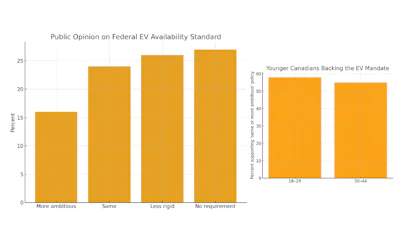
Just 27 percent oppose any federal requirement for more electric vehicles, while 16 percent want the policy to be more ambitious, 24 percent want it to stay roughly the same, and 26 percent favour making it less rigid or easier to achieve.
Younger Canadians show stronger support. Among those aged 18 to 29, 58 percent want the policy maintained or strengthened; among those 30 to 44, the figure is 55 percent.
With Ottawa weighing whether to allow more Chinese and European EVs into the market, the survey also asked about prices. More than half of respondents—52 percent—believe Canadians pay more for EVs than drivers in other countries. Twenty-one percent think prices are about the same, while just six percent believe cars are cheaper here.
As part of its 60-day review, the federal government has proposed rewarding automakers who sell EVs priced under $40,000 or offer zero-interest financing. When presented with this affordability-focused version of the policy, 46 percent of Canadians supported it, while 18 percent preferred the current approach and 24 percent opposed it—down from 27 percent opposition to the original policy. Support was highest in British Columbia, where half of respondents backed the affordability plan.
The survey also examined public reaction to Ottawa’s pause of its $5,000 federal EV rebate program in early 2025. Although Prime Minister Mark Carney has pledged to reintroduce a new rebate, the uncertainty has slowed sales. Among those open to buying an EV, 41 percent said they would delay purchasing until incentives return, 14 percent would buy without one, 36 percent said they would not buy an EV, and nine percent were unsure.
Trevor Melanson, director of communications at Clean Energy Canada, said the findings send a clear message. “A very strong majority of Canadians ultimately support keeping in place a version of Canada’s Electric Vehicle Availability Standard,” he said. “The question for Mark Carney is how the policy should adapt, not whether it should exist.”
Carney delayed the 2026 sales quota—which would have required 20 percent of all new passenger vehicles to be zero-emission— citing U.S. tariffs and financial pressure on automakers. Environmental groups warn that the pause risks undermining Canada’s emissions goals.
“As Canadians rightly realize they’re paying more for EVs than people in other countries, an approach centred on lowering upfront costs would be well received,” Melanson added. “Transportation is the second-biggest expense for households after housing, and lower-priced EVs would unlock major savings both on day one and over the long term.”
The change comes amid a broader reset of federal climate policy. In March, Carney repealed the household carbon tax introduced under Justin Trudeau, calling it divisive during a time of high inflation. Industrial carbon pricing remains, but Canada’s emissions strategy now depends more heavily on targeted subsidies and regulations such as the EV mandate and rebate program.
The online survey polled 2,230 Canadians between September 12 and 17, 2025. Results were weighted to reflect census data. A comparable probability sample would have a margin of error of plus or minus 2.08 percentage points, 19 times out of 20. Totals may not equal 100 due to rounding.


Under the previous government, the mandate included a goal that by 2026, 20 percent of all new passenger vehicles sold in Canada be zeroemission. That target rested on assumptions about technological adoption, consumer demand, supply chains, and automakers’ ability to scale production and distribution.
When Mark Carney became Prime Minister (and took over oversight of climate and industry policy), he delayed the enforcement of the 2026 quota. Citing pressures on automakers—especially from U.S. tariffs, economic headwinds, and supply chain constraints—Carney’s administration paused the implementation.