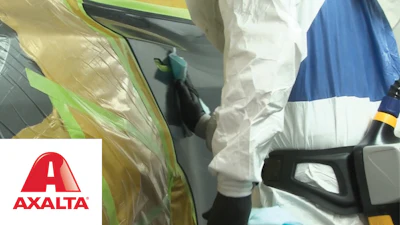
Proper surface cleaning in automotive refinishing requires understanding three methods—soapy water, pre-sanding cleaners, and surface cleaners—each with different VOC regulations and application rules to ensure compliance and quality paint adhesion.
- Three cleaning options exist: soapy water (removes organic contamination), pre-sanding cleaners (solvent-based, pump bottle required), and surface cleaners (water-based, 50g/litre VOC limit)
- VOC regulations apply differently: pre-sanding cleaners must use pump bottles to limit evaporation, while surface cleaners have a maximum 50g/litre solvent limit
- Common compliance mistake: many technicians incorrectly use pre-sanding cleaners as final wash before paint application, which violates regulations
- Aerosol exemption: solvent-based cleaners in non-refillable aerosol cans are exempt from VOC limits but prove costly for shops
- Compliance risk: inspectors review purchasing records and heavy solvent-based product usage can trigger regulatory red flags and fines
Proper surface preparation is a critical step in achieving high-quality results in automotive refinishing. Whether restoring a vehicle’s appearance or completing collision repairs, technicians rely on effective cleaning and preparation methods to ensure coatings adhere correctly and perform as intended. However, regulations around product use—particularly those targeting environmental impact—have introduced additional layers of complexity.
The Canadian law on the concentration of volatile organic compounds (VOCs) in automotive refinishing products came into force almost 15 years ago, yet some confusion still remains about the correct preparation of surfaces to be repainted, especially when it comes to the surface cleaning operations.
There are three options for cleaning surfaces: soapy water, cleaners to remove stains and prepare surfaces for sanding and surface cleaners.
SOAPY WATER
Soapy water is the first step, no matter what repairs need to be made. This removes any organic contamination that other products can’t (tree sap, insects, mud, calcium, etc.).
Anyone who has ever tried to remove a hand mark from a part that has been handled without gloves knows that only soapy water will effectively remove this type of contamination.
PRE-SANDING CLEANERS
Pre-sanding cleaners are made up of solvents and there’s no maximum VOC limit in the regulations. They are be classified as degreasers. However, the regulations require that they be applied using a pump bottle (pressurized bottle) to limit the solvent evaporation in the air.
These cleaners can only be used before sanding, to remove tar stains for example. The following is part of the text in the legislation: Cleaning products in manual spray bottles used to prepare surfaces prior to sanding are not covered by the VOC regulations.
This is where confusion persists in many workshops. Many paint technicians believe that if they are still on sale, they can still be used as a final wash before applying colour, for example. Another belief is that if the solvent cleaner is in a spray bottle, then they can be used as a surface cleaner for all operations, which is not true.
SURFACE CLEANERS
The regulations define surface cleaners as follows: A product used to prepare motor vehicle surfaces for the removal of foreign matter prior to the application of a coating.
A coating could be an undercoat, basecoat colour or single stage finish. Surface cleaners have a VOC limit of 50g/litre. This means that for every 1 litre of product used, 50 g of solvent will evaporate in the air. This also explains why surface cleaners are water-based to meet this limit.
EXCEPTION
The only exception to the regulation is for products in aerosol cans. The regulation does not apply to automotive refinishing products that are imported, sold or offered for sale in a non-refillable aerosol container. This means that a solvent-based cleaner in an aerosol could be used as a final cleaner before paint. This however would prove quite costly. A pump bottle is refillable, and therefore not exempt.
CONCLUSION
It’s the responsibility of each shop to ensure compliance with VOC regulations. Inspectors can easily review your purchasing records and compare the volumes of solvent-based versus water-based cleaners. If your usage skews heavily toward solvent-based products, it may raise red flags and put your shop at risk of non-compliance.