The five largest collision repair consolidators operate only 13.3% of U.S. repair locations but generate 31.7% of industry revenue, with over $9 billion in private equity capital invested in the sector since 2023. While independent facilities still account for 68.7% of locations, consolidation continues as investors target regional operators, though acquisition activity slowed 60.3% in the first half of 2025 due to higher borrowing costs and integration challenges.
- The five largest consolidators operate 4,019 of approximately 40,000 U.S. collision repair locations but generate 31.7% of total industry revenue
- Over $9 billion in private equity capital has entered the collision repair sector since 2023, with more than 130 PE firms actively investing
- Boyd Group Services is the largest consolidator with 1,312 collision locations, accounting for 29.4% of the five largest groups' U.S. operations
- Acquisition activity fell 60.3% in the first half of 2025 compared to 2024, driven by higher borrowing costs, tariffs, and integration challenges
- Insurer relationships are the primary factor affecting business value, with buyers favoring multi-shop operators with direct repair programs from multiple insurers
The five largest collision repair consolidators operate 13.3% of U.S. repair locations but generate an estimated 31.7% of industry revenue, according to a new report on private equity investment in the sector.
CT Acquisitions estimates the five groups operate at least 4,019 locations in a market of approximately 40,000 collision repair facilities.
Its Private Equity in Auto Body and Collision Repair: The 2026 Consolidation Report also identifies more than 130 private equity firms active in collision repair and estimates more than US$9 billion in private equity capital has entered the sector since 2023.
Independent facilities and smaller regional groups still account for an estimated 68.7% of U.S. collision repair locations.
The report said investors are increasingly targeting regional operators with between 3 and 12 locations, which can be used as the foundation for new repair networks.
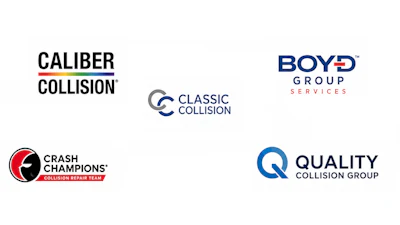
It profiles Caliber Collision, Crash Champions, Classic Collision, Quality Collision Group and Winnipeg-based Boyd Group Services among the largest active buyers.
Boyd has 1,312 collision locations, with 131 in Canada and 1,181 in the United States.
That means the Canadian-owned company operates about 29.4% of the 4,019 U.S. locations attributed to the five largest consolidators and close to 3% of all U.S. collision repair facilities.
Boyd runs Boyd Autobody & Glass and Assured Automotive in Canada and Gerber Collision & Glass in the United States.
Its US$1.3-billion acquisition of Joe Hudson’s Collision Center added 258 U.S. facilities in January 2026. Boyd expects the acquisition to generate between US$35 million and US$45 million in annual savings after integration.
Canadian pension capital is also invested in Caliber, the largest operator identified in the report. OMERS Private Equity, the investment arm of the Ontario Municipal Employees Retirement System, remains among Caliber’s investors.
The report also examines Driven Brands’ CARSTAR, Abra and Fix Auto USA franchise systems. CT Acquisitions separates those networks from consolidators that own repair facilities because their growth generally comes through franchise agreements and shop conversions.
Acquisition activity has slowed.
Openings and acquisitions by the five largest consolidators fell 60.3% during the first half of 2025 compared with the same period in 2024.
CT Acquisitions attributed the slowdown to higher borrowing costs, tariffs, parts supply concerns and the integration of previous acquisitions.
The report also identifies insurer relationships as the largest factor affecting the value of a collision repair business.
Buyers favour multi-shop operators with direct repair program relationships involving several insurers. The report said buyers generally prefer no single insurer to account for more than 25% of revenue.
OEM certifications, electric vehicle repair capabilities, I-CAR Gold Class recognition, technician retention and consistent cycle time may also increase a company’s value.
CT Acquisitions estimates single-location businesses may sell for between 2.5 and 4.5 times seller’s discretionary earnings. Regional multi-shop operators may attract between 3.5 and 6.5 times earnings before interest, taxes, depreciation and amortization. Larger groups capable of becoming new private equity platforms may attract between seven and more than 10 times EBITDA.
The firm cautioned that most collision repair transactions are private. Its valuation ranges are estimates based on industry sources and its own acquisition advisory work.