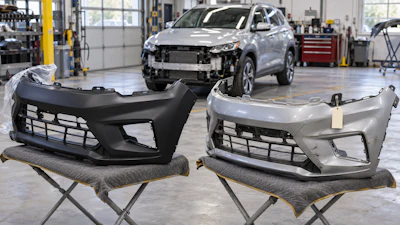
Hyundai Motor America now prohibits the use of aftermarket and recycled parts for crash repairs, citing safety concerns about detecting prior damage, joining similar restrictions from General Motors and Ford despite Canadian insurers' preference for lower-cost replacement parts.
- Hyundai changed its stance from does not recommend to does not approve aftermarket and recycled parts for collision repairs
- The restriction applies to genuine Hyundai parts from collision-damaged vehicles due to difficulty detecting prior crash damage or environmental exposure
- General Motors strictly prohibits unapproved salvage parts while Ford restricts recycled and aftermarket sensors in driver assistance systems
- Canadian insurers actively encourage cheaper alternative parts, with aftermarket and recycled parts usage rising to 28.7% in Q4 2025 from 25.7% a year earlier
- A conflict exists between OEM repair procedures and insurer policies, with some Canadian insurers stating their cost-control measures take precedence over manufacturer guidance
A November statement from Hyundai Motor America says the company “does not approve” of using aftermarket or recycled parts to repair crash damage. The previous statement said Hyundai “does not recommend” their use. The change follows similar moves at General Motors and Ford and comes as Canadian insurers continue to encourage the use of lower-cost replacement parts.
The new wording also covers genuine Hyundai parts taken from collision-damaged vehicles. The statement cites the difficulty of detecting damage from an earlier crash or exposure to the elements. For work that could affect occupant safety, U.S. Hyundai dealers must use genuine parts or demonstrate that a substitute is equivalent in quality and design.
Whether the revised position applies to Hyundai-certified collision repair centres in Canada remains unclear. OEMRepairInfo, the Canadian industry’s repair information portal, still links to the earlier U.S. statement.
A Sept. 18 statement from General Motors says the company “strictly prohibits” unapproved salvage, recycled and aftermarket parts on Chevrolet, Buick, GMC and Cadillac vehicles. Ford and Lincoln’s May guidance rules out recycled and aftermarket sensors used in driver assistance systems. Nissan Canada’s published guidance already rules out aftermarket, reconditioned and recycled bumper covers fitted with sonar sensors, citing the risk of misalignment.
Canadian insurers have a direct role in which parts go into an estimate. The Insurance Corporation of British Columbia tells its participating bodyshops to consider recycled or aftermarket parts on every estimate unless replacement coverage applies. Its program guide says the insurer’s policy takes precedence when it conflicts with a manufacturer’s repair procedures and cites the use of recycled and aftermarket parts as an example. Manitoba Public Insurance measures each participating shop’s parts savings by comparing what the shop bills with the price of equivalent new factory parts.
The use of aftermarket, recycled and remanufactured parts in Canada rose to 28.7% in the fourth quarter of 2025 from 25.7% a year earlier, according to figures from Ryan Mandell, vice-president of strategy and market intelligence at estimating software provider Mitchell. In a separate North American measure, parts distributor LKQ reported a rate above 40% in the second quarter of 2026. Justin Jude, then LKQ’s president and chief executive, attributed part of the rise to agreements between insurers and large repair networks that call for greater use of alternative parts.
Vince Edivan, executive director of the U.S.-based Automotive Recyclers Association, questioned the treatment of used factory sensors in an August response to GM’s restrictions. If a sensor can stay on a vehicle after a crash once it passes inspection, diagnostic checks and calibration, he said, “an undamaged OEM component from another vehicle should be evaluated under those same standards.”