
There's no shortage of impressive technology at SEMA. Every year, manufacturers arrive in Las Vegas with new tools, new ideas and promises to make life easier for the people working on vehicles. But separating a genuinely useful product from something that simply looks good on a show floor isn't always easy.
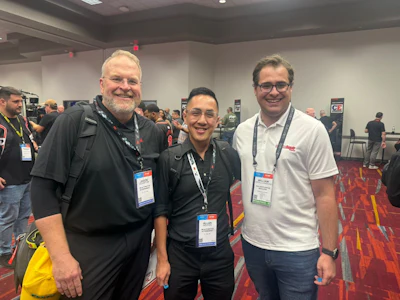
That was the challenge, and the privilege, of serving as a judge for the Media's Choice Awards at the SEMA 2026 New Product Showcase.
It was an honour to be part of the judging process, particularly with so many strong entries competing for attention. What made the experience especially rewarding was the opportunity to look beyond the displays and consider what these products could actually mean for collision repair facility owners, managers and technicians.
After all, a new product should do more than turn heads. It should solve a problem, save time, improve repair quality or help a facility become more profitable.
Three products stood out, each tackling a very different part of the collision repair process.
3M Precision Finish Nozzles
Sometimes, the smallest changes can make a big difference. That's certainly the thinking behind 3M's Precision Finish Nozzles.
Rather than relying on traditional machined-metal nozzle designs, 3M has developed five uniquely shaped fluid tips and nozzles using micro-injection moulding. The redesigned internal geometry features streamlined curves, multiple channels and rounded edges, allowing for excellent paint atomization at lower air pressures.
For painters, that means the potential for better application and greater control. For repair facility owners, it offers an opportunity to improve productivity in one of the most demanding areas of the repair process.
Celette WebTools AI
Structural repair has always depended on having the right information, the right equipment and the confidence to use both correctly.
Celette's WebTools AI brings artificial intelligence into that equation, offering a digital approach to accessing vehicle repair information and supporting structural repair operations.
As vehicles become more complicated and repair procedures more demanding, technicians need accurate information without spending unnecessary time searching for it. Celette's approach recognizes that the value of repair equipment increasingly depends on the information and software supporting it.

Identify by AirPro and Revv
If there's one area of collision repair where uncertainty can quickly become expensive, it's ADAS calibration.
Identify, developed by AirPro and Revv, tackles a question repairers face every day: How do we know which calibrations are actually required?
The system reviews OEM requirements, the repair estimate and vehicle scan information to identify necessary calibrations. It then goes a step further, asking targeted follow-up questions to capture details that might not appear in a scan or estimate.
That gives technicians a way to confirm calibration requirements while the vehicle is still in the repair bay, with documentation supporting why the work is needed.
Keep an eye out for the upcoming Collision Repair magazine Buyers' Guide, where we'll take a closer look at all three selections, explore what makes them different and examine what they could mean for Canadian collision repair facilities.