AI-powered guided photo capture is transforming collision repair intake by generating accurate estimates in minutes instead of days, allowing shops to reduce cycle times by 25 percent while boosting customer satisfaction and sales through faster scheduling and better customer communication.
- AI photo capture generates estimates in minutes instead of the traditional 5-7 day intake process
- One Canadian collision centre reported a 17% sales increase, 25% cycle time reduction, and 34% drop in non-drive cycle time
- Non-technical staff can capture photos for AI estimating, freeing technicians to focus on repair planning instead of documentation
- Customers can now complete intake from home using a guided photo app and receive estimates before arriving at the shop
- AI accuracy improves with each use, making it a tool that enhances rather than replaces skilled technicians and administrators
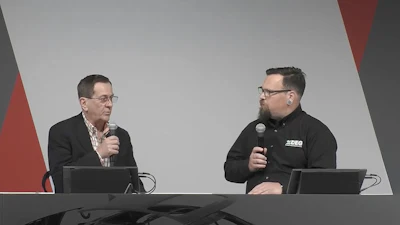
Toronto, Ontario -- AI technology is giving collision repair facilities the opportunity to save days of production time before vehicles ever reach a technician, Solera senior vice-president Bill Brower told moderator Danny Gredinberg, a Database Enhancement Gateway representative, during a presentation at the 2025 SEMA Show in Las Vegas on November 4.
Brower said many shops still rely on an outdated intake routine. Customers wait for insurer approval, book appointments days out, drive to the shop only to schedule repairs later. “For a customer to get an estimate and get their car scheduled, it might be five to seven days,” he said. He called that delay “a wasted opportunity” for both the shop and the customer.
Solera is pushing guided photo capture as a way to shortcut that timeline. Brower said the system generates an AI-supported estimate in minutes, even if someone without technical training takes the photos. “Anyone — even someone on the administrative side — goes out and takes a few pictures for AI estimating,” he said. "The estimator then reviews it for about five minutes."
Brower said the effect for bodyshop technicians is simple: it allows them to spend less time documenting and more time planning repairs.
According to Brower, the system also improves as shops use it. “The accuracy improves with each estimate,” he said. That, he argued, makes AI more of a tool for technicians and administrators than a replacement for them.
“It won’t take the place of talented people,” he said. “It helps talented people be even more efficient.”
Gredinberg said a faster intake gives staff room to communicate properly with a customer instead of rushing through paperwork and photos. The time saved becomes time spent managing expectations. “You can focus more on the conversation with the client,” he said.
He added that talking through a repair plan has value shops often overlook.
Brower highlighted one Canadian collision centre that has adopted the model, reporting a 17 percent increase in sales, a 25 percent reduction in cycle time and a 34 percent drop in non-drive cycle time. He said the shop also boosted customer satisfaction and reached insurer incentive benchmarks other locations could not.
“Not only did cycle times decrease, but customer satisfaction scores increased as well,” he said.
The shift now extends beyond the shop doors. Brower said recent developments allow customers to complete intake from home using a guided photo app.
“If they want to take pictures, the shop can send a link that walks them through the process,” he said.
After submitting photos, customers receive an estimate and can book a repair before ever arriving at the bodyshop.
Still, Brower said adoption depends on consistent use among appraisers and managers. He warned that many shops abandon new tools too early.
“You have to test and learn,” he said. “We’re creatures of habit… you’ve got to stay the course.”
Gredinberg shared the same outlook, noting that each iteration pushes the technology further. “I believe it’s the future,” he said. “There’s room for it to get even better.”