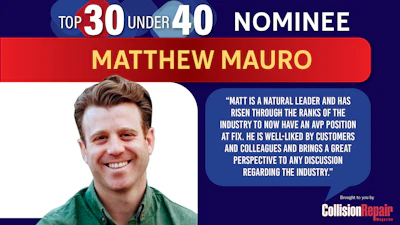

Matthew Mauro is the associate vice president of sales and operations at Fix Network who transitioned from hospitality management into collision repair, where he now focuses on addressing industry challenges like technician shortages and emerging technologies while building strong relationships across the industry.
- Matthew Mauro serves as associate vice president of sales and operations at Fix Network after entering the collision repair industry through a family referral
- He was nominated for 30 Under 40 by Mike Beier, president and CEO of Consolidated Dealers' Co-Operative, who praises his leadership and industry perspective
- Key industry challenges he addresses include technician shortages, emerging technologies, OEM requirements, shop efficiency, and AI integration
- Matthew believes emerging technologies and AI are growth opportunities that can improve shop efficiency, repair accuracy, and attract next-generation talent
- His leadership philosophy centers on collaborating with industry partners and staying connected at all levels to anticipate change and drive meaningful progress
Matthew Mauro’s entry into the collision repair industry began with a referral from a family member. At the time, Matthew was completing his Bachelor of Business Administration focused in Hospitality Administration and Management. “What began as a referral quickly turned into a passion,” said Matthew, who is now the associate vice president of sales and operations at Fix Network.
Matthew was nominated for 30 Under 40 by Mike Beier, president and CEO of Consolidated Dealers’ Co-Operative, who calls himself Matthew’s “colleague, competitor and friend.” “Matt is a natural leader and has risen through the ranks of the industry to now have an AVP position at Fix,” said Mike. “He is well-liked by customers and colleagues and brings a great perspective to any discussion regarding the industry.”
From the outset, Matthew has been committed to delivering excellence to key stakeholders, and while that drive has stayed steady, his motivation has evolved over time. “My motivation has evolved into a deeper appreciation for the complexity and impact of this industry and a continual desire to help shape its future,” Matthew said. While Matthew is not originally from the collision business, Mike says Matthew has “found his niche, leaned on his hospitality expertise and made it his own.”
It’s hard for Matthew to choose just one moment in his career that he’s particularly proud of, but his relationships with people are a source of inspiration. “What stands out most consistently are the relationships built and the impactful outcomes delivered to our partners,” he told Collision Repair magazine. “Each successful collaboration that brings value to both the business and the people involved is a source of pride and motivation.”
Likewise, it’s difficult for Matthew to name only one challenge the industry is currently facing because many of them are interwoven, such as emerging technologies, evolving OEM requirements, shop efficiency, technician shortages and the role of AI. “I’m passionate about addressing these collectively, as progress in one area can positively influence others,” said Matthew. “By working closely with industry partners, I aim to help implement solutions that not only address today’s needs but also prepare us for the future.”
Collaborating with subject matter experts, shop owners, managers and technicians is how Matthew stays ahead of the curve. “Understanding their perspectives and day-to-day challenges provides invaluable insight into where real opportunities for improvement exist,” Matthew said. “Staying connected at all levels of the industry is key to anticipating change and driving meaningful progress.” Matthew believes that emerging technologies are opportunities for growth and innovation, such as advanced equipment and AI.
“These tools can significantly improve shop efficiency, enhance repair accuracy and ultimately create better outcomes for all stakeholders,” said Matthew. “I see these innovations not just as tools for performance but also as gateways to attract the next generation of talent.” His mission, in his view, is clear: “My role is to help bridge today’s realities with tomorrow’s potential, ensuring we evolve in a way that benefits both the industry and the people who power it.”