The CCS Precision 2026 conference brought collision repair operators together to address industry consolidation, workforce development, and repair quality standards, with industry leaders emphasizing that consistent repair results depend on disciplined processes, clear standards, and commitment to precision as a core business practice.
- Up to 50% of Canadian collision repair businesses could disappear within five years without strategic positioning and adaptation.
- CCS network has doubled business volume in three years and could double again if current growth continues.
- Precision requires measurement as a foundation—repair estimates must be logical, accurate, and supported by clear photographic and documentary evidence.
- Key focus areas include repair documentation quality, employee skills development through I-CAR training programs, and estimating accuracy standards.
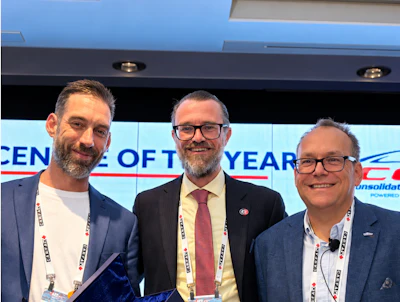
- Three facilities recognized for excellence: Star Collision (Ottawa) won Collision Centre of the Year, Dent Clinic Plus (Calgary) won the Precision Award, and Gord Anderson Collision Centre (Woodstock) won the Enterprise Mobility Award.
Collision repair operators have examined industry consolidation, workforce development and repair documentation at the Precision 2026 conference in Niagara Falls, Ont., on Oct. 15.
Consolidated Collision Services (CCS), a division of Consolidated Dealers Co-operative Inc., held the conference alongside the Automotive Conference and Expo (ACE) 2026. Members and industry partners attended sessions on business strategy, technical education and ways to improve repair performance.
Mike Beier, president of Consolidated Dealers, opened the conference by challenging attendees to treat precision as an ongoing business commitment. He emphasized consistency, accountability and disciplined execution as foundations for reliable results.
Charles Aubry, general manager of CCS, followed with an assessment of consolidation and the network’s growth. He discussed changes across the insurance, dealership and distribution sectors, comparing those developments with the pressures facing collision repair operators.
Looking ahead five years, Aubry suggested that as many as 50% of Canadian collision repair businesses could disappear. He emphasized strategic positioning and the ability to adapt as factors in the long-term success of independent repairers.
Aubry also outlined growth within CCS. The network has doubled its business volume over the past three years and could double it again over the next three if the current pace continues, he said.
Several presentations addressed practical ways to improve operations, develop employees and produce consistent repair results.
Brandon Roy, an instructor with NCM Associates, explored precision throughout a collision repair business, including estimating and recruitment. He emphasized measurement as a foundation for improving performance and gave attendees assignments to apply the concepts discussed. Roy also distributed copies of his book, *Stand Out Anyway*.
Stu Klein, executive director of I-CAR Canada, outlined training programs and pathways available to help businesses develop employee skills and build stronger teams.
Danny Gredinberg, administrator of the Database Enhancement Gateway (DEG), addressed common estimating challenges. He introduced resources to help estimators answer everyday questions and find their way through technical information.
Attendees also participated in ACE programming at the Fallsview Casino Grand Hall, including a keynote address featuring Bob Rae.
The afternoon sessions covered customer financing, estimating accuracy and repair documentation.
Roger Saran of Rifco National Auto Finance introduced a financing program that gives customers options for paying their insurance deductible or the full cost of vehicle repairs.
Jerry Gastineau of Mitchell International concluded the technical presentations with a discussion of estimating accuracy and repair file quality. He emphasized that estimates must be logical, accurate and supported by clear evidence.
Photographs and documents should establish the circumstances of an accident and demonstrate why the recommended repairs are necessary, Gastineau explained.
The conference also recognized three facilities for their performance within the CCS network.
Star Collision in Ottawa received the 2026 CCS Collision Centre of the Year Award. Beier and Aubry presented the award to Jason Tanguay, the facility’s collision centre manager.
Dent Clinic Plus in Calgary received the CCS Precision Award. Jason Arnott of CCS presented the award to Bill Moore, owner, and Sandra Andrisani, national project manager.
Gord Anderson Collision Centre in Woodstock, Ont., received the Enterprise Mobility Award for its performance in length of rental (LOR), ARMS and growth in 2026. Lindsay Bleach of Enterprise Mobility presented the award to Laura Thibideau, the facility’s collision centre manager.
Closing the conference, Aubry returned to precision in everyday operations. He emphasized that consistent repair quality depends on disciplined processes, clear standards and the commitment of the people carrying out the work.
The CCS conference concluded on Oct. 15. ACE programming continued on Oct. 16 with further sessions on skills development, repair standards and certifications.